
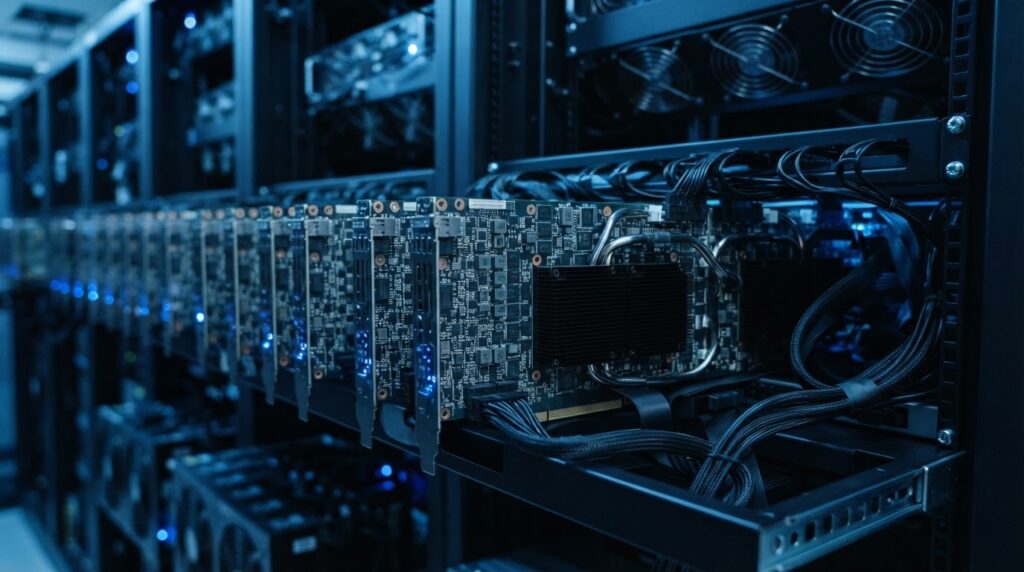
The latest AI infrastructure news is about more than training larger models. As companies build agents that keep context across long tasks and handle sensitive business data, the underlying computing system has to solve new problems too. On November 9, 2026, Google announced two additions to its eighth-generation TPU portfolio: TPU 8tx and TPU 8i Max.
What Google announced
Google describes TPU 8tx as a system for confidential inference, where sensitive data can be processed with hardware-level security protections. TPU 8i Max is designed for workloads with very large context windows and greater compute density. The two systems join TPU 8t and TPU 8i, which Google says are aimed at different stages of the AI lifecycle.
The distinction matters because an AI service is not just a chip. Memory, networking, storage, and software determine how efficiently a model can respond and how much information it can work with at once. Google’s announcement emphasizes this system-level design, especially for agentic workloads that may need to retain and use extensive context.
Why this update matters
For organizations, the announcement points to two practical priorities: keeping sensitive workloads protected while they run, and reducing bottlenecks when AI systems need to process long histories or large codebases. If these systems perform as intended, cloud providers and enterprise teams may have more choices when matching infrastructure to a particular job.
Google says its TPU systems support PyTorch and open-source software and that nearly 100 customers use its TPU platform. Those are company statements; the November announcement does not provide independent benchmarks that compare the new systems with competing accelerators. Buyers should look for verified availability, pricing, workload-specific performance, and security details before making procurement decisions.
What to watch next
The key question is how quickly developers can access the new systems and whether their real-world performance improves cost, speed, or security for particular workloads. A specialized accelerator can be useful, but only when software support, capacity, and operational fit are there too.
The bigger takeaway is that AI infrastructure is becoming more specialized. The race is not only to build capable models; it is also to deliver the memory, security, and system design needed to run them reliably.
Primary source
Google’s announcement of TPU 8tx and TPU 8i Max — published November 9, 2026.