
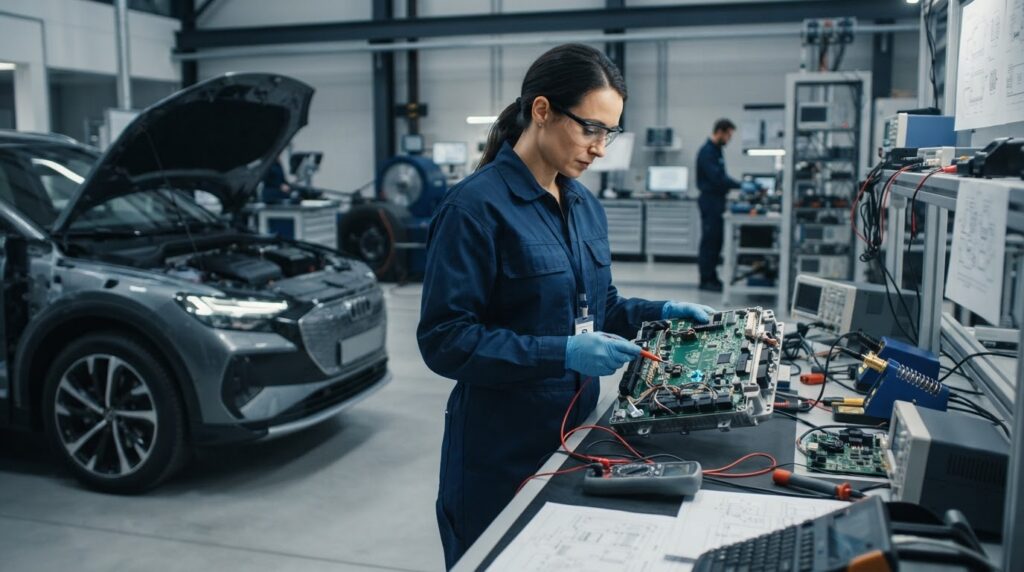
Cars increasingly rely on software for features that used to be controlled by separate electronic units. That shift is making automotive computing more centralized and more demanding. On November 4, 2026, Infineon announced AURIX RC1, its first AURIX microcontroller platform based on the open-standard RISC-V instruction set architecture.
What Infineon announced
Infineon says AURIX RC1 is designed for software-defined vehicles and other physical AI applications. The company describes a common, scalable controller foundation that can serve multiple vehicle domains, including body and chassis control, battery management, powertrains, driver assistance safety management, and cockpit applications.
The company says the planned family can scale up to 12 32-bit processing cores, include a parallel processing unit for edge AI, and offer up to 40 megabytes of embedded memory, depending on the product. Infineon is targeting samples in the first half of 2027, so the platform is an announced roadmap rather than a product that customers can buy today.
Why RISC-V matters here
RISC-V is an open instruction set architecture, which gives chip designers flexibility in how they build processors and product families. In automotive, that flexibility has to coexist with strict safety, cybersecurity, reliability, and long product lifecycles. Infineon says it is pairing the architecture with its existing safety and automotive software ecosystem.
The larger trend is the software-defined vehicle: a car where more functionality can be updated, integrated, or improved through software over time. Shared hardware foundations can make it easier for automakers to consolidate computing and reuse software across vehicle systems. But real adoption depends on toolchains, supplier support, safety validation, and long-term availability—not only on the processor architecture.
What to watch
The next milestones are engineering samples, development tools, customer validation, and evidence that software can move across the platform with manageable effort. Infineon says its DRIVECORE ecosystem will support software development and migration, but automakers will need to assess that against their own requirements.
AURIX RC1 is worth watching because it links two major technology shifts: RISC-V’s growing role in specialized computing and the move toward more software-defined vehicles. Its effect will become clearer as samples and production plans progress.
Primary source
Infineon’s AURIX RC1 announcement — published November 4, 2026.